
Some engineering components are designed to be noticed. Others spend their entire working lives doing an important job quietly and efficiently, hidden inside machinery. The ball bearing belongs firmly in the second category. Yet, outside the world of engineering, small metal balls have also found a rather unexpected second life: in children’s toys and games.
For generations, ball bearings have helped machines move smoothly, reduce friction and withstand considerable loads. At the same time, their simple shape, weight and ability to roll have made them surprisingly useful in toys. From traditional games and construction sets to mazes and mechanical toys, the humble bearing has become part of childhood in ways that many people probably never considered.
A Small Component With A Big Job
At its most basic, a ball bearing consists of balls positioned between rings, allowing one surface to rotate against another with considerably less friction. The principle is simple, but its applications are enormous.
Bearings can be found in everything from electric motors and pumps to bicycles, vehicles, industrial machinery and countless other pieces of equipment. Their job may not seem particularly glamorous, but without bearings, many of the machines we take for granted would be heavier, less efficient and much more difficult to operate.
The beauty of the design is its simplicity. A precisely manufactured ball can roll extremely efficiently, allowing rotational movement to take place with far less resistance than would be possible if two surfaces were simply rubbing against one another.
That same basic property is precisely what makes a ball bearing so interesting outside engineering.
When Engineering Meets Play
Children’s toys have long relied on simple mechanical principles. Wheels, gears, springs, magnets, levers and pulleys can all turn an ordinary object into something entertaining and educational.
Ball bearings fit naturally into this world because they are small, smooth, durable and capable of rolling in a wonderfully predictable way.
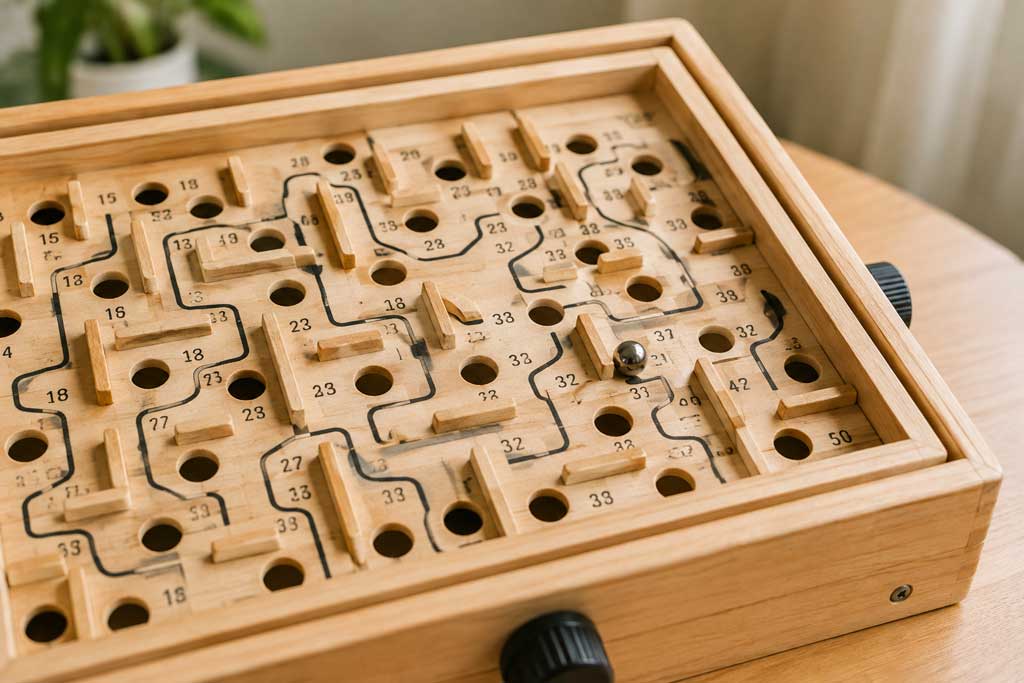
One of the best-known examples is the tabletop maze. The player has to guide a small metal ball around a series of obstacles, usually by carefully tilting the playing surface. It is a deceptively simple challenge, but it relies on the same physical properties that make bearings so useful in machinery.
The ball wants to roll. Gravity determines its movement. The player has to control both.
That combination creates a toy that is not only entertaining but also introduces children to basic ideas about balance, movement, gravity and control without them necessarily realising they are learning anything at all.
From Bearings To Toys
Not every toy containing a metal ball uses a technically correct ball bearing. In many cases, the component is simply a steel ball or similar precision-made sphere. However, the connection is easy to understand.
The engineering world produces incredibly consistent spherical components because machinery depends upon them being manufactured to precise dimensions. Once those same characteristics are applied to toys, they become useful for creating movement and interaction.
A metal ball can roll down a track, trigger another component, travel through a maze, alter the balance of a mechanism or become part of a larger construction system.
This is where the worlds of engineering and play overlap.
The Appeal Of Something So Simple
There is something particularly satisfying about a metal ball bearing compared with many modern toy components. It has weight. It feels solid. It rolls smoothly across a surface and can gather surprising speed over a short distance.
For children, that can make even a basic mechanical toy fascinating.
Part of the appeal is also the fact that the movement is visible. Unlike a bearing hidden inside a motor, a ball rolling through a toy allows the user to see the mechanical principle at work.
A child may not know what friction is, understand how rotational force works or appreciate the importance of tolerances in manufacturing. They simply know that the ball rolls — and that getting it to where it needs to go is harder than it looks.
An Unlikely Piece Of Engineering Heritage
It is easy to think of engineering components as belonging exclusively to factories, workshops and industrial machinery. But many of the principles developed for engineering eventually find their way into everyday life, sometimes in surprisingly subtle forms.
The ball bearing is a good example.
Something designed to make industrial machinery operate smoothly can also become part of a child’s afternoon spent trying to guide a steel ball through a maze. The underlying physics hasn’t changed. Only the application has.
That is perhaps what makes the ball bearing so interesting. It demonstrates how a relatively simple engineering idea can have a life far beyond its original purpose.
Still Rolling Along
Today, ball bearings remain an essential part of modern engineering. They are manufactured to extraordinary levels of precision and continue to play a vital role in machinery across almost every industrial sector.
At the same time, the basic concept remains familiar to anyone who has ever played with a mechanical toy, navigated a tabletop maze or watched a small metal ball race along a track.
The ball bearing may have started life as an engineering solution to the problem of friction, but its usefulness has never been confined to machinery.
Sometimes, the most important components are also the simplest — and occasionally, they end up in the toy box.
Featured image credit: AI generated.